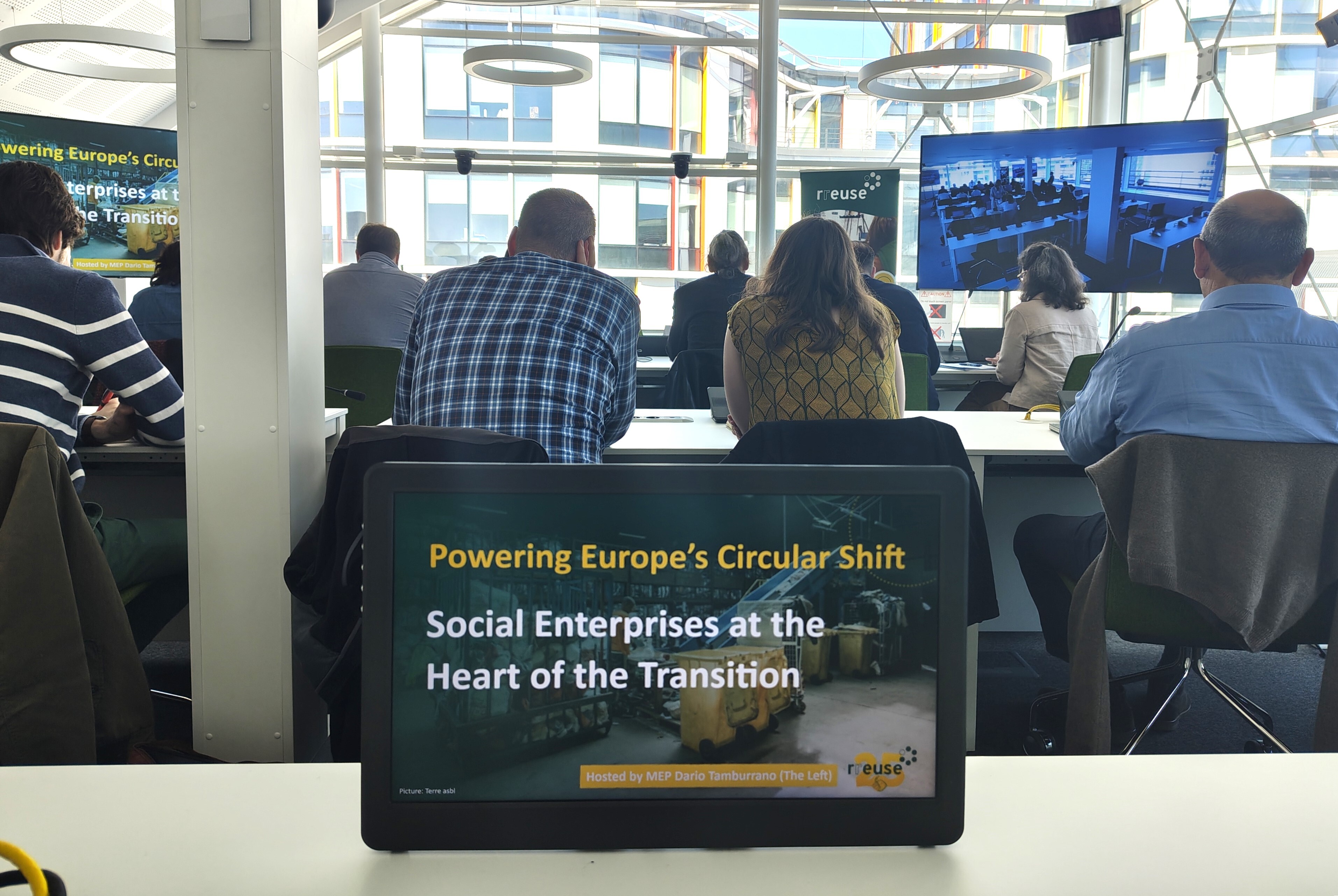
To mark its 25th anniversary, RREUSE brought together policymakers, social enterprises and EU officials at the European Parliament for a forward-looking discussion on how to build a truly circular and resilient European economy. Held on 22 April, coinciding with Earth Day, the event “Powering Europe’s Circular Shift: Social Enterprises at the Heart of the Transition” looked ahead to major upcoming EU initiatives, including the proposed Circular Economy Act (CEA) and the next phase of the Social Economy Action Plan (SEAP).
Opening the discussion, host MEP Dario Tamburrano (The Left) underlined that the circular economy is not only about sustainability, but also about Europe’s ability to withstand shocks. He pointed to the EU’s strong dependence on resources and materials as a strategic weakness that reuse, repair, and recycling can help address. “Reuse, repair and recycling are the foundation of a resilient and sustainable Europe,” he said, adding that the current geopolitical context should “strengthen, rather than weaken, the EU’s commitment to the Green Deal”.
This link between circularity and resilience ran through the whole event.
Brigitte Fellahi-Brognaux, Head of Unit for Social and Inclusive Entrepreneurship at the European Commission, explained how the Social Economy Action Plan has had to adapt to a rapidly changing context marked by COVID-19, inflation and the war in Ukraine. “Recent political shifts and challenges have highlighted the resilience of the social economy sector”, she noted. While most actions under the plan have been carried out, some bottlenecks remain, especially when it comes to access to finance. Looking ahead, she highlighted the need to strengthen access to funding for social economy actors, support partnerships and integration into value chains, and ensure stronger recognition across EU policies. “The social economy is living proof we can have an inclusive, social and competitive economy,” she said, pointing out that the sector “plays an important role across sectors and policies, including industrial, environmental and those aimed at supporting democracy.” Ms Fellahi-Brognaux also pointed out the ongoing work on public procurement, noting the current revision of the Directive, which offers “an opportunity to enhance socially responsible procurement”.
Attention then turned to the role of the European Parliament, where MEPs shared their perspectives on how to better support circular social enterprises.
MEP Yvan Verougstraete (Renew) stressed that today’s market rules often fail to reflect the real value created by sustainable activities. “Competition should not mean a race to the bottom. Just because something is cheaper does not mean it has the same value,” he argued, calling for clearer rules and support tools such as reserved contracts. Mr Verougstraete also underlined that public procurement should better reflect this by prioritising value over price.
MEP Katrin Langensiepen (Greens/EFA) placed the debate in a wider social context, stressing that “the social economy must be seen as the future opportunity and alternative to our current system,” linking support for the social economy to broader challenges such as poverty, ageing populations and working conditions. She called for stronger public investment, clear political choices in upcoming EU budget decisions, and better use of public procurement as a powerful lever for change.
These political perspectives were followed by contributions from our social enterprise representative members from across Europe. They pointed to concrete challenges on the ground, including:
- limited support for development beyond the “start-up” phase in some Member States,
- the way Extended Producer Responsibility (EPR) schemes are designed,
- how waste streams are allocated.
Their questions on fair competition, procurement and governance highlighted a persistent gap between policy ambitions and what happens in practice.
In the second half of the event, the discussion shifted to the upcoming Circular Economy Act, widely seen as a major opportunity to steer Europe’s circular transition.
MEP Delara Burkhardt (S&D) warned against the risk that the Circular Economy Act becomes merely a recycling act, stressing the role of social enterprises as often being the first point of contact for citizens engaging with circularity, through second-hand shops and community initiatives. She also pointed to the visible consequences of overproduction, noting that in many places textile collection systems are already under strain. For Ms Burkhard, this underlines the need to address the root causes of waste generation, not just its management.
MEP Bruno Tobback (S&D) underlined that “the circular economy is a big booster of employment in Europe,” highlighting its potential to create local, inclusive jobs. He stressed that activities such as reuse, repair and sorting are largely rooted in local communities, thereby contributing to building stronger local economies. At the same time, Mr Tobback echoed MEP Burkhardt's concerns about the direction the Circular Economy Act could take, warning that too much focus on critical raw materials and “quick wins” could sideline the broader contribution of the social economy and reduce circular policy to narrower industrial priorities.
MEP Sirpa Pietikäinen (EPP) called for clearer rules and a longer-term vision, including binding targets and a stronger link with the waste hierarchy. She emphasised the need to rethink economic incentives, pointing out that “reuse and repair are penalised by multiple layers of taxation, including VAT—we need tax reform to incentivise them”, and stressed that “products should be designed to live longer, be reused and repaired, and the circularity hierarchy must become a binding principle”.
The discussion at the European Parliament showed that, after 25 years of RREUSE’s advocacy, the challenge ahead is no longer to demonstrate the value of social enterprises as essential circular economy actors, but rather to develop EU policies that fully support their on-the-ground work, which has proven its efficiency. With key legislative developments on the horizon, the coming months will be critical for turning this recognition into concrete supportive measures that allow social enterprises to scale their social and environmental impact locally across Europe.