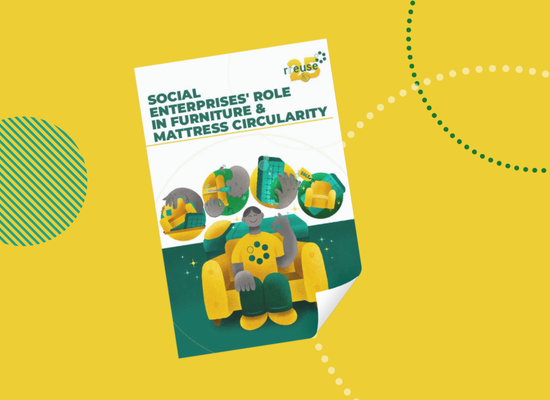
On 29 April, RREUSE publishes a new research report, “Social Enterprises’ Role in Furniture and Mattress Circularity”, revealing the essential role social enterprises play in tackling Europe’s growing challenge of furniture and mattress waste, while addressing social exclusion. The research, developed in collaboration with IKEA Social Entrepreneurship, highlights how these actors are already implementing innovative approaches but face persistent barriers.
Furniture and mattresses are among the most logistically complex and under-optimised waste streams. Each year, around 10.5 million tonnes of furniture are consumed in the EU, yet around 90% is landfilled or incinerated.1 This stands in stark contrast with persistent furniture poverty, where 27.5 million people across the EU experience severe material and social deprivation.2
Drawing on 14 case studies from across Europe, the report shows how social enterprises are uniquely positioned to address these challenges simultaneously. Through a wide range of activities – from kitchen removals and resale in Ireland, mattress dismantling and recycling in France, upcycling and resale of office furniture in Belgium, to a federation of furniture banks and reuse centres in the Czech Republic – these social enterprises extend product lifespans, create inclusive jobs, and ensure essential household goods reach communities, whether at affordable prices or donated directly to people in need.
Despite their positive impact, social enterprises continue to face persistent challenges, including limited physical space, inadequate funding, as well as skill and capacity gaps. As a result, they operate below their full potential, and some even cease their operations entirely. Nevertheless, the report also identifies conditions that enable their resilience and development, such as strong social and circular mission, skills development, strong partnerships and the ability to tailor innovative approaches to local contexts.
“Europe continues to waste valuable resources and miss a crucial opportunity to tackle furniture poverty and social exclusion through circular solutions. This opportunity lies in harnessing the potential of social enterprises that are indispensable in building a real circular economy for bulky products. Targeted investments, consumer awareness, enabling policy frameworks, and strategic partnerships could bring them from the margins and significantly scale their positive impact in bulky waste management and beyond.” - Neva Nahtigal, RREUSE Director.
1 European Environment Bureau (2017) Circular economy opportunities in the furniture sector. (Available here).
2 European Commission. (2024). Living conditions in Europe – material deprivation and economic strain. (Available here).