On 23 April 2026, our General Assembly adopted the RREUSE Strategy 2026–2030: Advancing a job-rich and inclusive circular Europe, co-created with its members. Coming at a time of climate urgency, resource scarcity and widening inequalities, the strategy sets out how RREUSE and its members will work to ensure that circular policies deliver both environmental and social benefits.
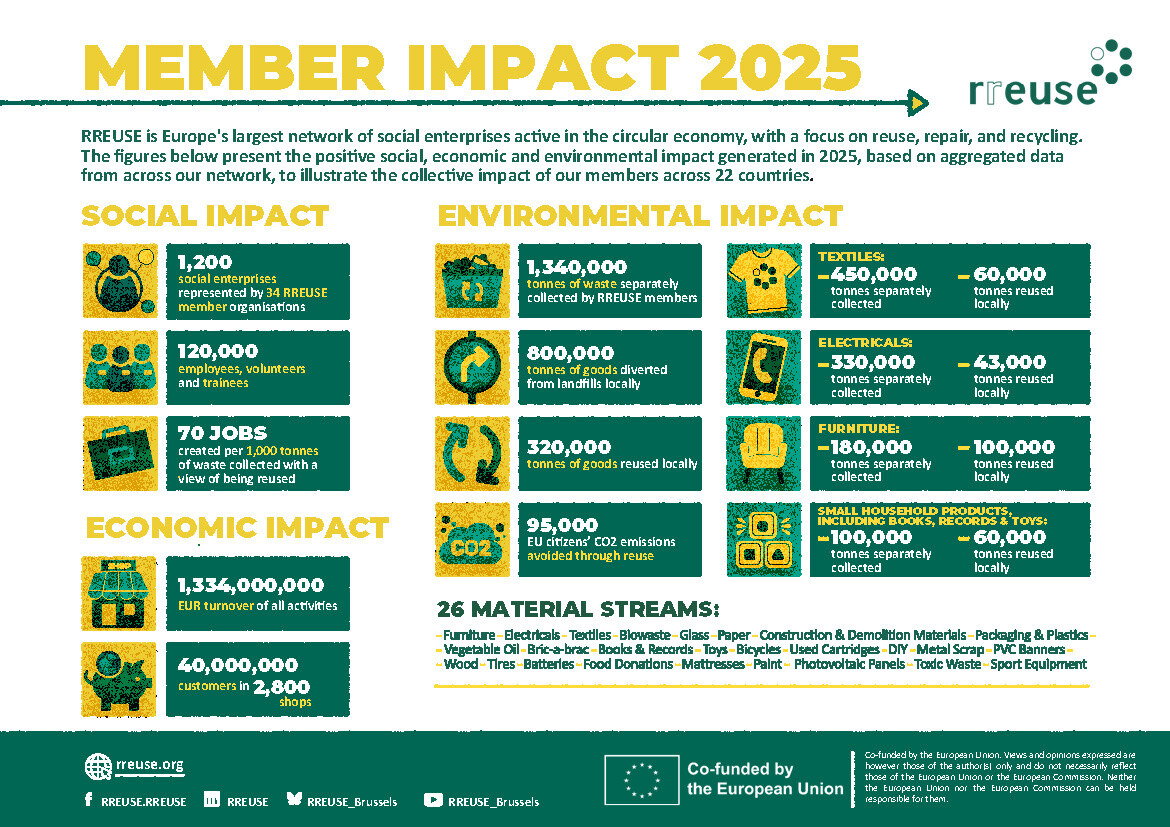
RREUSE represents 1,300 social enterprises across Europe that extend product lifetimes, reduce waste and the use of virgin materials, and create training and job opportunities for people facing barriers to the labour market. Building on 25 years of experience, the new strategy strengthens RREUSE’s role as a community builder, knowledge hub and policy voice for the social circular economy.
By 2030, RREUSE envisions a Europe where circular social enterprises are recognised as key economic actors; reuse and repair are fully embedded in policy, markets and consumer behaviour; and social inclusion is a defining feature of circularity.
To achieve this, the strategy is structured around three interconnected pillars:
- Community – We will deepen engagement with our members and strengthen our shared identity as a vibrant, cohesive network. RREUSE is more than a representative body; it is a platform where social enterprises meet, align strategies and shape common positions.
- Academy – We will invest in training, peer learning, practical tools and research to help our members grow, innovate and demonstrate their impact. The Academy will also help us share knowledge with external stakeholders and support evidence-based policymaking on the social circular economy.
- Outreach – We will continue to advocate for policies that reflect the realities and potential of social enterprises, while raising the visibility of our members’ work and supporting the development of stronger ecosystems across Europe.
These three pillars reinforce one another. Insights from our community feed into the Academy’s learning and research, which in turn strengthen our advocacy and communications. Our Outreach work then creates new opportunities for our community and helps mobilise resources for the sector.
To deliver the strategy, RREUSE will also invest in its own resilience as a network, including transparent and participatory governance, diversified funding, improved digital infrastructure and closer collaboration with allied European networks.
With this strategy, RREUSE renews its commitment to a circular economy that works for people and the planet. Social enterprises in reuse, repair and recycling already demonstrate that such an economy is possible in practice, creating local jobs, strengthening communities and reducing inequalities while protecting the environment.
RREUSE invites social circular enterprises and their networks, policymakers, partners and funders to engage with the RREUSE Strategy 2026–2030 and to join in building a job‑rich and inclusive circular Europe.